Our work
Our Framework & Platform
We are a leading company dedicated to empowering individuals to achieve their dreams through innovative solutions and exceptional services.
At BrainCrime, we do not view crime as a product of a “criminal brain,” a single diagnosis, or biological destiny. Instead, we use a dimensional, evidence-based framework that integrates neuroscience, psychology, social context, and ethics to understand why harm occurs and how it can be prevented.
Our work combines rigorous research, responsible interpretation, and a practical digital platform designed to support prevention, education, and policy—without predicting individuals or undermining responsibility.
At BrainCrime, we do not view crime as a product of a “criminal brain,” a single diagnosis, or biological destiny. Instead, we use a dimensional, evidence-based framework that integrates neuroscience, psychology, social context, and ethics to understand why harm occurs and how it can be prevented.
Our work combines rigorous research, responsible interpretation, and a practical digital platform designed to support prevention, education, and policy—without predicting individuals or undermining responsibility.
The Brain–Behaviour–Context Framework
Our framework is built on one central principle:
Crime does not originate in the brain alone.
It emerges when biological vulnerability, psychological traits, and social context interact over time.
This approach reflects the best available evidence from neuroscience, psychiatry, criminology, and public health, while remaining compatible with legal responsibility and ethical governance.
Discover Our Journey So Far
We are a leading company dedicated to empowering individuals to achieve their dreams through innovative solutions and exceptional services.
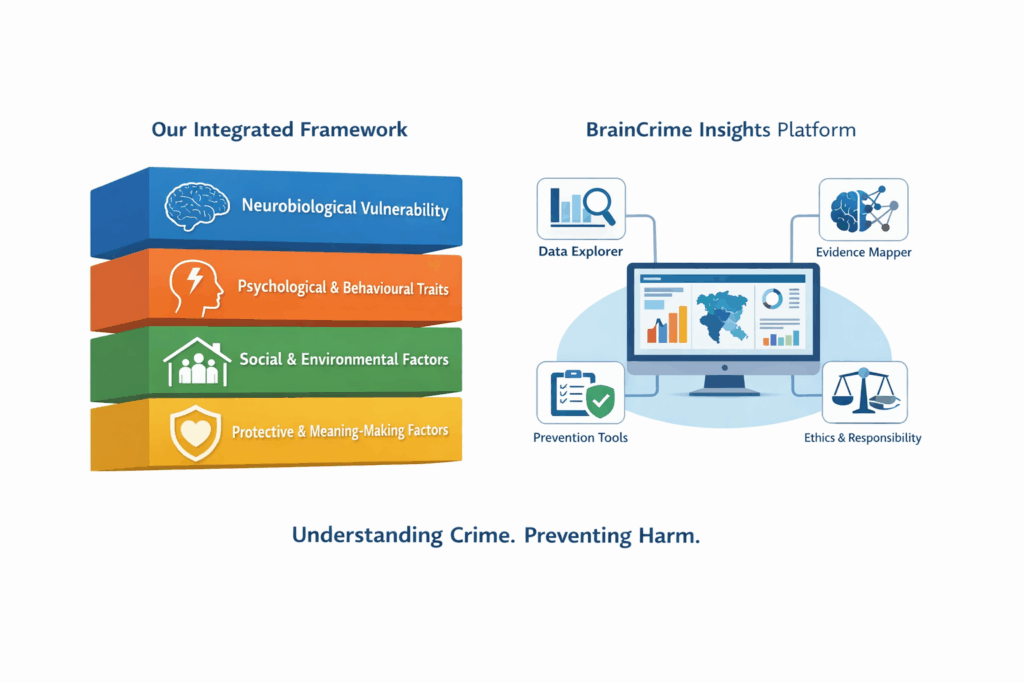
Neurobiological Vulnerability (Not Destiny)
We examine brain systems involved in emotion regulation, threat sensitivity, impulse control, and social cognition—based on population-level research, not individual diagnosis.
No “criminal brain”
No prediction of behaviour
No deterministic claims
Neuroscience is used to understand vulnerability, not to label or excuse actions.
Psychological & Behavioural Traits
Traits linked to antisocial outcomes—such as irritability, aggression, impulsivity, emotional dysregulation, and psychopathic features—exist along continuous dimensions and are often modifiable.
This is where prevention, education, and treatment have the greatest impact.
Social & Environmental Context
Biology and psychology operate within real-world environments.
We integrate evidence on:
Childhood adversity and trauma
Education and opportunity
Substance exposure
Social exclusion and inequality
Institutional experiences (schools, care, prisons)
Context shapes outcomes. Ignoring it leads to failed prevention.
Protective & Meaning-Making Factors
Prevention is not only about reducing risk—it is about strengthening protection.
We focus on:
Education and mental health access
Community cohesion
Moral and ethical development
Cultural and religious meaning systems
Rehabilitation and reintegration
This layer ensures that responsibility, dignity, and social repair remain central.
The BrainCrime Insights Platform
To turn this framework into real-world impact, we are developing the BrainCrime Insights Platform—a responsible digital environment for research, education, and prevention-focused analysis.
What the Platform Does
The platform allows users to:
Explore public, aggregated datasets related to crime, health, education, and social conditions
Examine how antisocial vulnerability emerges at population level, not in individuals
Map evidence across neuroscience, psychology, and social research
Generate insights for prevention, education, and policy
The platform is designed to inform decisions, not to predict behaviour or identify individuals.
Data Explorer
Interactive dashboards for exploring public datasets and research findings across regions, age groups, and time—without individual identification.
Evidence Mapper
Visual tools linking behavioural traits, neural systems, and social context, showing overlap, uncertainty, and limits of interpretation.
Prevention Scenario Tools
Educational and policy-relevant tools to examine how changes in education, mental health access, or social support may reduce harm at population level.
Ethics & Responsibility Hub
Resources on moral development, responsibility, community resilience, and ethical use of neuroscience—developed with experts in ethics and religious studies.
Research Workspace
A secure environment for students and researchers to explore data, run predefined analyses, and produce transparent, citable outputs.
Purpose
To identify emerging population-level signals of risk and protection before harm escalates — without profiling individuals or predicting crime.